

Table of Links
-
Some recent trends in theoretical ML
2.1 Deep Learning via continuous-time controlled dynamical system
2.2 Probabilistic modeling and inference in DL
-
3.1 Kuramoto models from the geometric point of view
3.2 Hyperbolic geometry of Kuramoto ensembles
3.3 Kuramoto models with several globally coupled sub-ensembles
-
Kuramoto models on higher-dimensional manifolds
4.1 Non-Abelian Kuramoto models on Lie groups
4.2 Kuramoto models on spheres
4.3 Kuramoto models on spheres with several globally coupled sub-ensembles
-
5.1 Statistical models over circles and tori
5.2 Statistical models over spheres
5.3 Statistical models over hyperbolic spaces
5.4 Statistical models over orthogonal groups, Grassmannians, homogeneous spaces
-
6.1 Training swarms on manifolds for supervised ML
6.2 Swarms on manifolds and directional statistics in RL
6.3 Swarms on manifolds and directional statistics for unsupervised ML
6.4 Statistical models for the latent space
6.5 Kuramoto models for learning (coupled) actions of Lie groups
6.6 Grassmannian shallow and deep learning
6.7 Ensembles of coupled oscillators in ML: Beyond Kuramoto models
-
Examples
7.2 Linked robot’s arm (planar rotations)
7.3 Linked robot’s arm (spatial rotations)
7.4 Embedding multilayer complex networks (Learning coupled actions of Lorentz groups)
-
5.3 Statistical models over hyperbolic spaces
Although probability measures over hyperbolic spaces may seem an exotic topic at the first glance, recent developments in Geometric DL indicate that well understood and tractable families of this kind would play a central role in many ML algorithms. Since many data sets coming from different fields are naturally embedded into hyperbolic spaces, the corresponding statistical models are necessary for sampling, density estimation, inference and probabilistic modeling.
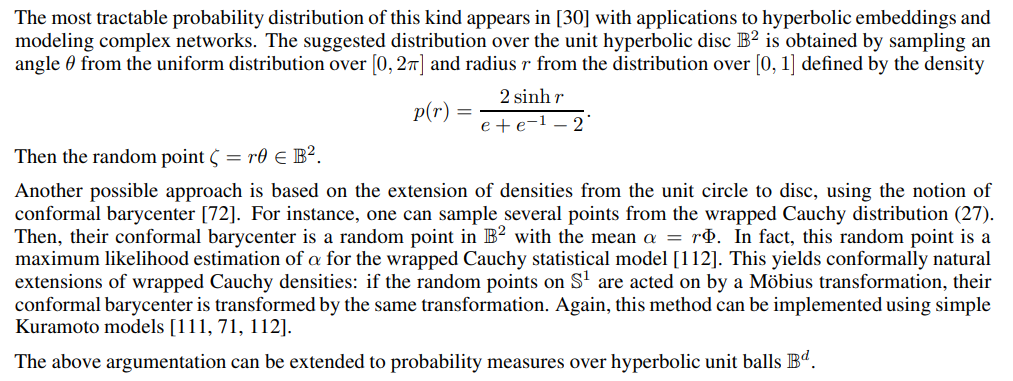
For yet another alternative, we refer to the paper [45] which presents an inference algorithm over hyperbolic spaces with an application to word embeddings. This algorithm is based on another family, named "hyperbolic normal distributions" in the paper. We find this statistical model pretty inconvenient, mostly because it does not posses any group-invariance properties.
Author:
(1) Vladimir Jacimovic, Faculty of Natural Sciences and Mathematics, University of Montenegro Cetinjski put bb., 81000 Podgorica Montenegro ([email protected]).
This paper is